
Catalytic Ozone Removal Filters: Working Principle, Applications, and Selection
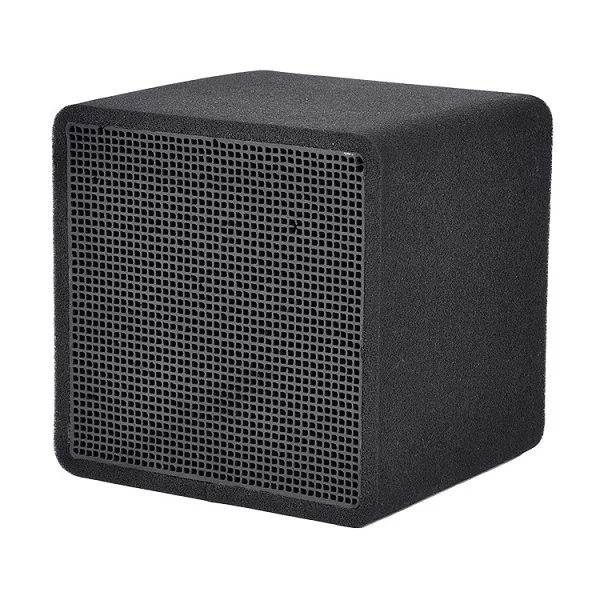
Ozone is a double-edged molecule. Deliberately generated, it is one of the most effective disinfection and deodorization agents in industry — inside disinfection cabinets, water treatment contactors, and odor-control systems. But ozone that escapes the process is a regulated air pollutant: it irritates airways at concentrations as low as 0.1 ppm, degrades rubber and plastics, and fails indoor-air-quality audits. Any equipment that makes ozone — or makes it incidentally, as laser printers and electrostatic precipitators do — needs an end-of-line answer for the residual.
That answer, increasingly, is the catalytic ozone removal filter: a passive component with no power draw and no consumable media that converts ozone back to ordinary oxygen on contact. Here is how it works, why it beats adsorption, and how to select one.
The Problem: Why Residual Ozone Must Go
Occupational exposure limits for ozone are strict — typically 0.05–0.1 ppm as an 8-hour average — because ground-level ozone is a respiratory irritant and a documented asthma trigger. Meanwhile the list of ozone sources keeps growing:
- Office equipment: laser printers and copiers generate ozone at the corona charging assembly on every page
- Air cleaning technology: electrostatic precipitators (ESP), ionizers, UV photolysis units, and plasma sterilizers all emit ozone as a byproduct
- Deliberate ozonation: water treatment contactors, ozone generators, and disinfection cabinets vent residual O₃ at end of cycle
Venting raw exhaust is rarely acceptable — indoors for health reasons, outdoors for environmental compliance. Something has to destroy the ozone, reliably, for years, without creating a maintenance burden.
Why Catalysis Beats Adsorption
The older approach is activated carbon: ozone-laden air passes through a carbon bed, and ozone reacts with or adsorbs onto the carbon surface. It works — until it doesn’t. Adsorption media have a finite capacity; they saturate, and performance falls off a cliff. Worse, saturation is invisible without monitoring, so replacement is either scheduled wastefully early or discovered dangerously late. The ozone-carbon reaction also slowly consumes the carbon itself and can release caught organics as secondary pollutants.
A catalytic filter works on a fundamentally different principle. The catalyst is a reaction facilitator, not a reactant: it provides a surface on which ozone decomposes, and emerges from every reaction cycle chemically unchanged. There is no capacity to exhaust and no saturation front. The filter’s service life is set by dust fouling of the surface — manageable with a cheap pre-filter — not by the ozone load processed. Rated lives of 10,000+ hours are routine.
The Mechanism: A Self-Regenerating Redox Cycle
Modern ozone decomposition filters load a manganese-based composite metal oxide catalyst onto a honeycomb substrate. At room temperature, ozone contacting the catalyst surface decomposes through a two-step redox cycle:
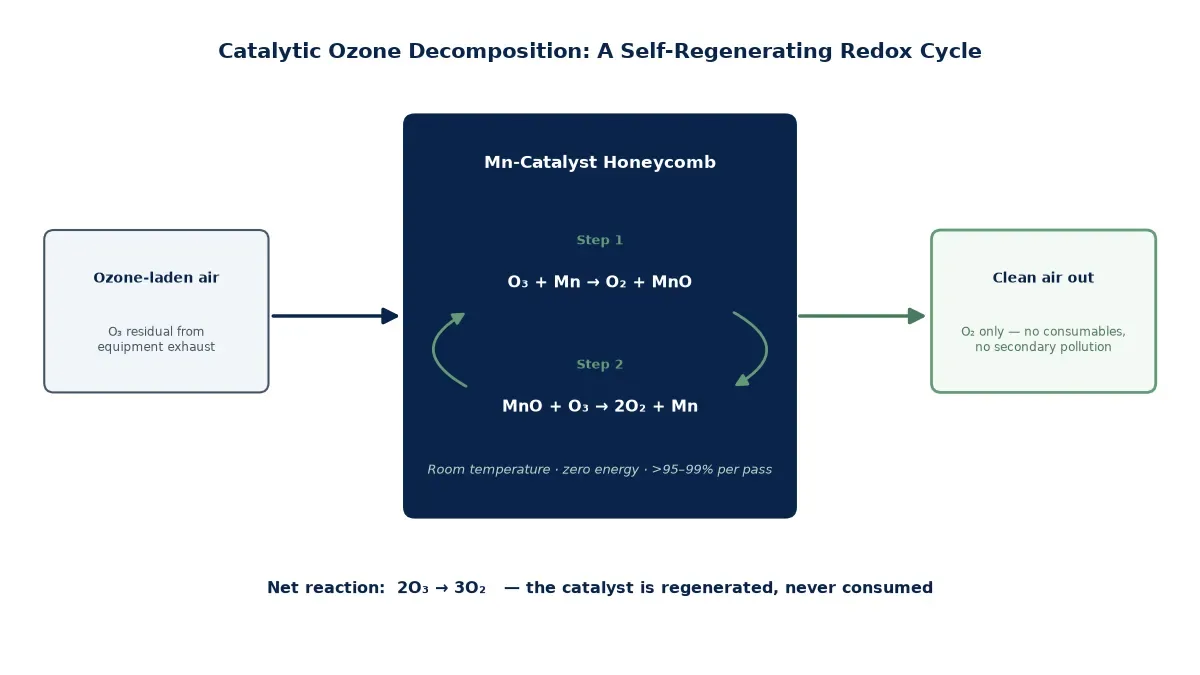
- Step 1: O₃ + Mn → O₂ + MnO — ozone oxidizes the catalyst surface, releasing molecular oxygen
- Step 2: MnO + O₃ → 2O₂ + Mn — a second ozone molecule reduces the surface back to its active state
The net reaction is 2O₃ → 3O₂, with the manganese site regenerated on every pass. No heater, no UV lamp, no power connection — the reaction runs at room temperature with zero energy input, which is why equipment OEMs can add ozone control without touching their electrical certification or thermal budget.
Substrate Matters: Aluminum Honeycomb vs. Ceramic Monolith
The catalyst needs a carrier with enormous surface area and low flow resistance, and honeycomb structures are the proven answer. Two substrate families cover different duty:
| Property | Aluminum honeycomb | Ceramic honeycomb |
|---|---|---|
| Cell density | 28–140 cells/in², selectable | 150–230 cells/in² standard |
| Strength / temperature | Good for equipment cavities | High crush strength, heat & corrosion immune |
| Best environment | Dry, compact, low-temperature cavities | Humid, hot, chemically aggressive airstreams |
| Typical host | Printers, copiers, compact purifiers | ESP systems, ozone generators, tail-gas ducts |
Polymer foam substrates exist for the most compact geometries but age under sustained ozone attack; for anything industrial, metal or ceramic is the professional choice.
The Numbers That Matter When Specifying
Per-pass efficiency. Well-designed catalytic beds destroy 95–99%+ of ozone in a single pass — verified values, for example, of >99% at 1.0 ppm inlet concentration, 1.0 m/s face velocity, 25°C, and 50% RH through a 50mm fine-cell bed. Efficiency scales with catalyst volume and contact time, so deeper beds and denser cells buy margin.
Pressure drop. The filter sits in the host equipment’s airstream, so its resistance must fit the existing fan curve. Honeycomb’s straight parallel channels keep this remarkably low: on the order of 7 Pa at 1 m/s for a 10mm panel, rising to roughly 52 Pa at 5 m/s. These are published, testable numbers your thermal engineer can design around — insist on them.
Service life. In a clean airstream, ≥10,000 hours; the governing aging mechanism is dust fouling, not catalyst exhaustion. A simple pre-filter extends life further.
Form factor. Standard ceramic blocks (e.g. 100×100×50mm) array into panels of any size; aluminum honeycomb elements are cut fully to drawing — shape, frame, and edge seal included.
Application Scenarios
Office and production print equipment — The classic duty: a filter cassette over the corona exhaust strips ozone at the point of generation, keeping the machine compliant with indoor-air emission limits for its entire service life.
Air purifiers and ESP systems — Any purifier using electrostatic precipitation, ionization, or UV photolysis needs a decomposition stage behind it, or it trades particulate pollution for ozone pollution.
Ozone generators and water treatment off-gas — Contactors and ozonation tanks must destroy residual ozone before venting; ceramic honeycomb destructors are the standard end-of-line component.
Disinfection and odor-control equipment — After an ozone-based sterilization or deodorization cycle, the purge air passes through the filter so rooms and chambers can be re-entered safely.
UV curing, photolysis, and plasma processes — Secondary ozone from industrial UV and plasma equipment is captured in the exhaust path with a catalytic stage sized to the duct.
Featured Product: Ceramic Honeycomb Ozone Removal Filter
For purifier, ESP, and process-air duty, our Ceramic Honeycomb Ozone Removal Filter carries the manganese-based catalyst on a rigid 100×100×50mm ceramic monolith (150 cells/in², 230 optional) with ≥1,500 m²/g carrier surface area, 95–99% purification efficiency, ≥10,000-hour service life, and face velocities up to 2.0 m/s — manufactured under ISO 9001 with SGS third-party testing and RoHS-compliant materials. Blocks array to any panel size; send us your airflow, ozone concentration, and available depth, and we will return a matched configuration.
For compact office-equipment cavities, see the aluminum-honeycomb Ozone Decomposition Filter for Printers & Copiers; for a plug-and-play assembly with integrated fan and HEPA pre-filtration, see the Rapid Ozone Removal Module.