Microporous Ozone Decomposition Filter | Aluminum Honeycomb Catalyst, Custom Sizes
Ozone decomposition filter with manganese catalyst on aluminum honeycomb — over 99% O₃ removal at room temperature, custom sizes for printers and copiers.
Product Overview
Every laser printer, copier, and multifunction device generates ozone. The corona charging assembly that conditions the photoreceptor drum ionizes the surrounding air on every page, producing a continuous low-level ozone stream that accumulates in the machine cavity and escapes into the office environment. Left uncontrolled, this is both an occupational-health liability and a compliance problem for equipment OEMs selling into markets with strict indoor-air emission limits. The Legia Smart microporous ozone decomposition filter is the drop-in engineering answer: a catalytic aluminum honeycomb element that converts ozone back to oxygen instantly at room temperature, with no power draw, no consumable saturation limit, and no secondary emissions.
The filter is built by loading a metal catalyst — manganese oxide compounded with rare-earth elements — onto a precision-formed aluminum honeycomb substrate, then high-temperature activating the coating so the catalytic sites are permanently bonded to the cell walls. When ozone-laden air passes through the honeycomb, O₃ molecules contact the catalyst surface and decompose to O₂ in a fraction of a second. Because the catalyst is a reaction facilitator rather than a reactant, it is not consumed: the filter keeps working at rated efficiency for its entire service life instead of filling up like an adsorption media.
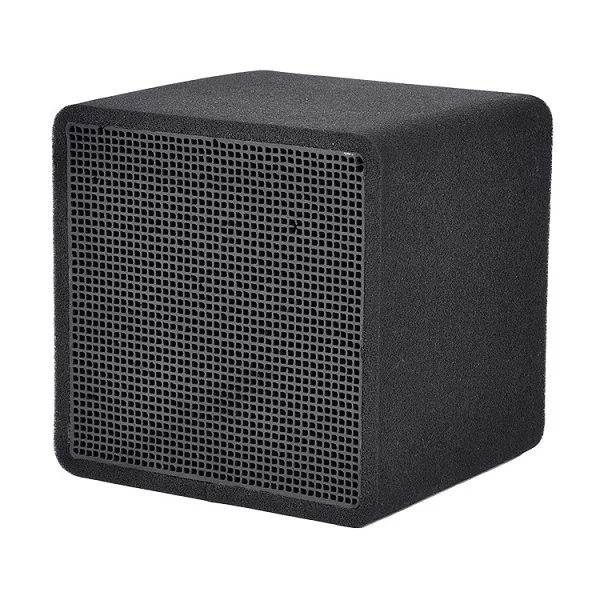
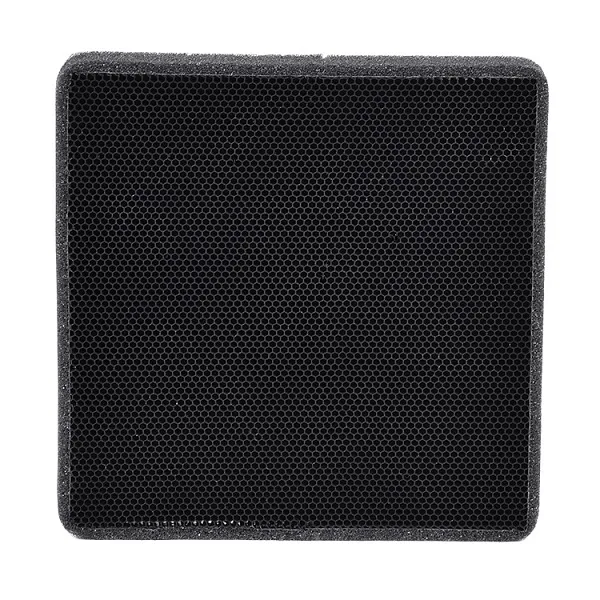
Two construction formats cover the full range of equipment integration needs: rigid aluminum honeycomb elements for framed filter cassettes and high-airflow exhaust paths, and flame-retardant foam supported versions for compact cavities where the filter must conform to irregular mounting geometry. Cell density is selectable from 28 to 140 cells per square inch across five standard grades, and every filter is manufactured to the customer’s dimensional drawing — from a 40mm square inside a desktop printer to a full-width array for a production-class copier line.
How Catalytic Ozone Decomposition Works
The decomposition of ozone on a manganese-based catalyst proceeds through a two-step surface redox cycle at room temperature:
Step 1 — O₃ + Mn → O₂ + MnO (ozone oxidizes the catalyst surface, releasing molecular oxygen)
Step 2 — MnO + O₃ → 2O₂ + Mn (a second ozone molecule reduces the surface back to its active state)
The net reaction is 2O₃ → 3O₂, with the manganese catalyst emerging unchanged from every cycle. This is what distinguishes catalytic decomposition from activated-carbon adsorption: there is no capacity to exhaust, no saturation front moving through the bed, and no performance cliff at end of life. As long as the catalyst surface remains physically accessible, the reaction proceeds at full rate — which is why the filter’s service life is defined by the cleanliness of the airstream rather than by the ozone load it has processed.
The honeycomb geometry is equally deliberate. A microporous aluminum honeycomb presents an enormous catalytic surface area — 750 to 1,700 m² per cubic meter of filter depending on cell grade — inside a structure with straight, uniform, parallel flow channels. Uniform pore formation is what keeps pressure drop low: air passes through the cells in near-laminar flow instead of fighting the tortuous path of a packed bed or fibrous mat, so the equipment’s existing cooling fan can drive the full rated airflow through the filter without an upgraded blower.
Core Advantages
- >99% One-Pass Ozone Removal — Why It Matters: At 1.0 ppm inlet concentration, 1.0 m/s face velocity, 25°C and 50% RH, a 50mm bed of fine-cell media removes up to 99% of ozone in a single pass — enough to bring even a heavily loaded copier exhaust stream below office air-quality guidelines without recirculation.
- Zero Energy Consumption — Why It Matters: The reaction runs at room temperature with no heater, no UV lamp, and no power connection. For equipment OEMs, that means no electrical certification burden, no thermal management, and no operating cost attached to the ozone control function.
- The Catalyst Is Never Consumed — Why It Matters: Adsorption media saturate and must be replaced on a schedule; a catalytic filter’s life is set by dust loading, not ozone loading. In a clean equipment cavity, service life stretches to years — and in dusty environments, a simple upstream pre-filter protects it.
- Low, Predictable Pressure Drop — Why It Matters: A 10mm panel adds only ~7 Pa at 1 m/s (a=0.4 grade) and ~52 Pa even at 5 m/s — published, testable numbers the thermal engineer can design around, not marketing claims. Five cell grades let you trade surface area against resistance to hit your fan curve exactly.
- Five Cell Grades, Any Dimension — Why It Matters: From H28 (28 cells/in², 3.0mm cells, lowest resistance) to H140 (140 cells/in², 1.3mm cells, maximum surface area), plus custom-cut shapes, frames, and foam-sealed edges — the filter is drawn around your machine, not the other way around.
- Certified Manufacturing — Why It Matters: Production under an ISO 9001 quality system with RoHS-compliant materials and third-party SGS testing gives equipment brands the documentation package needed for their own product certifications.
Typical Applications
Laser Printers & Copiers: The primary design target — mounted over the corona assembly exhaust or integrated into the machine’s main filter cassette to strip ozone at the point of generation.
Multifunction & Production Print Equipment: High-duty-cycle production printers and wide-format machines where continuous ozone generation demands a maintenance-free decomposition stage.
Medical & Laboratory Devices: Sterilizers, analyzers, and sample-handling equipment that generate or use ozone internally and must not emit it into clinical environments.
Office Air Purifiers: Dedicated ozone-removal stages in purifiers specified for print rooms, copy centers, and other high-print-density spaces.
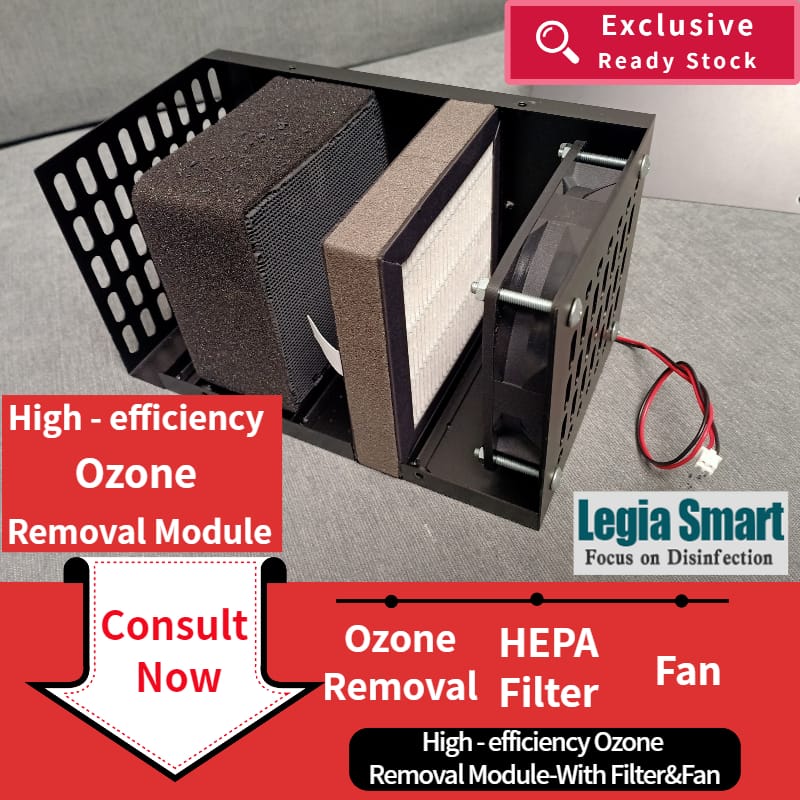
Need a complete, ready-to-install assembly with fan and HEPA pre-filtration? See our Rapid Ozone Removal Module with Fan and Filter. For higher-temperature and high-humidity process air, see the Ceramic Honeycomb Ozone Removal Filter.
Technical Specifications
Standard Cell Grades (Aluminum Honeycomb)
| Model | Cell Density (cells/in²) | Cell Side A (mm) | Specific Surface Area (m²/m³ equivalent, 1/m) | Available Thickness T (mm) | Availability |
|---|---|---|---|---|---|
| H28 | 28 | 3.0 | 750 | 10.0 / 20.0 | Standard stock |
| H60 | 60 | 2.0 | 1,000 | 10.0 / 20.0 | Standard stock |
| H72 | 72 | 1.8 | 1,200 | 10.0 / 20.0 | Standard stock |
| H100 | 100 | 1.5 | 1,500 | 10.0 / 20.0 | To order |
| H140 | 140 | 1.3 | 1,700 | 10.0 / 20.0 | To order |
General Parameters
| Parameter | Specification |
|---|---|
| Ozone Removal Efficiency | >99% one-pass (1.0 ppm inlet, 1.0 m/s, 25°C, 50% RH, 50mm fine-cell bed) |
| Catalyst | Manganese oxide + rare-earth composite, high-temperature activated |
| Substrate Options | Aluminum honeycomb; flame-retardant foam |
| Dimensions | Fully custom — cut to customer drawing (any shape, frame, or edge seal) |
| Pressure Drop (10mm panel, a=0.4) | ~7 Pa @ 1 m/s; ~20 Pa @ 3 m/s; ~52 Pa @ 5 m/s |
| One-Pass Efficiency vs Thickness | 10mm: 82–95% by grade; 50mm: up to 99% (1.0 ppm, 1.0 m/s) |
| Reaction Temperature | Room temperature — zero external energy |
| Quality & Compliance | ISO 9001 manufacturing; RoHS materials; SGS third-party tested |
| Packaging | Double-layer export cartons |
| Storage | Dry, room-temperature environment |
| Installation | Filter face perpendicular to airflow; seal panel perimeter so all air passes through the media |
Send us your cavity dimensions, airflow, and ozone load — our engineers will return a matched cell grade, thickness, and cut-to-size proposal.
Frequently Asked Questions
What is the price of the Microporous Ozone Decomposition Filter | Aluminum Honeycomb Catalyst, Custom Sizes?
Legia Smart disinfection equipment typically ranges from USD 50 to 200 depending on capacity, features, and customization. The H28–H140 Custom Series starts around USD 55. Request a quote for an exact price based on your order volume and configuration.
Do you offer OEM and ODM customization?
Yes. We provide full OEM/ODM services including custom branding, logo printing, packaging, and feature configuration. Our engineering team can adapt the cabinet capacity, sterilization modes, and control panel to your specifications.
What is the minimum order quantity (MOQ)?
MOQ is flexible and depends on the model and customization level. Sample orders are welcome for evaluation. Contact our sales team with your requirements for a tailored MOQ and lead time.
What certifications do your disinfection products carry?
Our equipment is manufactured to ISO and CE quality standards, with full documentation available for export. Compliance reports and test certificates can be provided on request.
What is the lead time and shipping options?
Standard lead time is 15 to 30 days for production, depending on order size and customization. We ship globally by sea or air with complete export documentation and support EXW, FOB, and CIF terms.
What warranty and after-sales support do you provide?
We offer a 12-month warranty against manufacturing defects, backed by remote technical support, spare-parts supply, and installation guidance to keep your equipment running reliably.
Modules & Accessories