Ceramic Honeycomb Ozone Removal Filter | Mn Catalyst, 95–99% Efficiency, 10,000h
Ceramic honeycomb ozone removal filter with Mn-based catalyst, 95–99% efficiency and 10,000-hour life — for air purifiers, ESP systems and ozone tail gas.
Product Overview
Wherever ozone is generated deliberately — corona discharge air cleaners, electrostatic precipitators, UV photolysis units, plasma sterilizers, ozone generators — some of it always escapes the process as residual tail gas. That residual ozone is a regulated pollutant: it attacks respiratory tissue, degrades rubber and plastics, and fails indoor-air audits. The Legia Smart ceramic honeycomb ozone removal filter is the passive end-of-line solution: a rigid ceramic monolith loaded with a manganese-based decomposition catalyst that converts residual O₃ back to O₂ at room temperature, continuously, with zero energy input and no consumable media to replace.
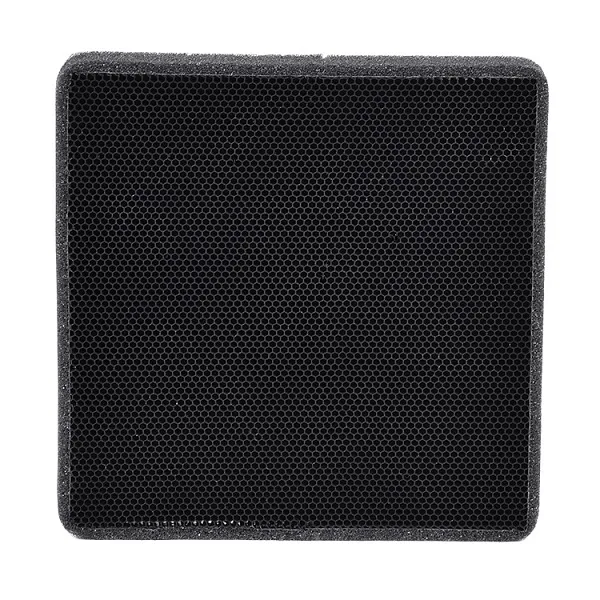
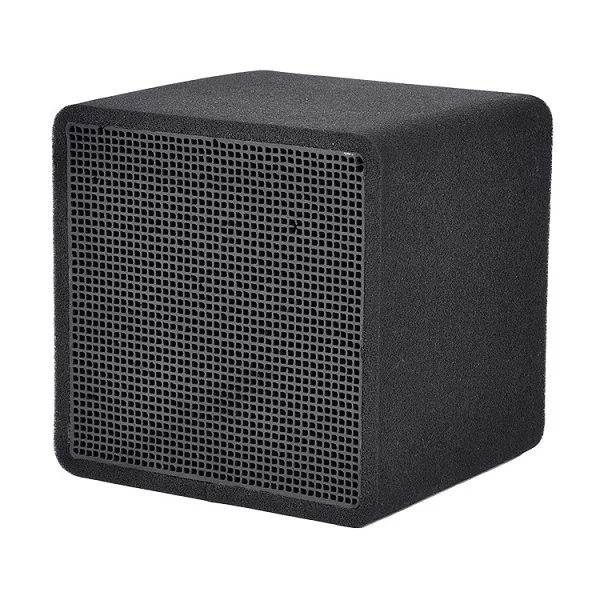
The substrate is a porous, thin-walled ceramic honeycomb — the same monolith architecture proven in automotive catalytic converters — chosen for properties polymer and metal substrates cannot match: high crush strength, dimensional stability at elevated temperature, corrosion immunity in humid and chemically aggressive airstreams, and a modular block format that stacks and arrays to any cross-section. The standard block is 100 × 100 × 50mm with 150 cells per square inch; blocks combine into panels of any area for ducts, purifier towers, and equipment exhaust plenums.
Catalytically, the filter carries a supported manganese-based composite metal oxide on a modified porous carrier with a specific surface area of at least 1,500 m²/g. Ozone contacting the surface decomposes through the two-step redox cycle — O₃ + Mn → O₂ + MnO, then MnO + O₃ → 2O₂ + Mn — regenerating the active site on every pass. Rated purification efficiency is 95–99% depending on working conditions and total catalyst volume, with a service life of at least 10,000 hours in a clean environment at a recommended face velocity of up to 2.0 m/s.
Why a Ceramic Substrate
Ozone tail-gas streams are among the harshest environments a filter can face: strongly oxidizing gas, frequent high humidity, temperature swings from the generating equipment, and in ESP applications, exposure to corona byproducts and fine particulate. Polymer foam substrates oxidize and crumble under sustained ozone attack; organic binders degrade; thin metal foils corrode at the coating interface. Ceramic is chemically indifferent to all of it. The monolith does not age in the airstream it treats, so the catalyst coating retains its mechanical support — and therefore its activity — across the full 10,000-hour service life.
The thin-wall, high-porosity cell structure keeps the other half of the equation in balance: pressure drop stays low enough for the host equipment’s existing fan. A 50mm block of 230-cell ceramic media adds roughly 7 Pa at 0.5 m/s and about 40 Pa at 2.0 m/s; a 13mm panel of 150–230 cell media holds under 52 Pa all the way to 4 m/s. And when installation space is constrained, increasing cell density — not fan power — is the designed-in lever for recovering conversion efficiency in a shallower bed.
Core Advantages
- 95–99% Catalytic Ozone Destruction — Why It Matters: Verified per-pass efficiency that scales with catalyst volume and contact time. Whether the target is a purifier’s emission spec or an industrial stack’s discharge limit, the dosage math is straightforward and the margin is engineerable.
- Zero Energy, Zero Consumables — Why It Matters: The reaction runs at room temperature and the catalyst is regenerated, not consumed, by the reaction itself. There is no heater to power, no carbon to change, and no saturation event to detect — operating cost is effectively the fan energy you already had.
- 10,000+ Hour Service Life — Why It Matters: In clean airstreams the rated life exceeds 10,000 hours, and the governing aging mechanism is dust fouling, not catalyst exhaustion — so a simple pre-filter extends life further. The cleaner your process air, the longer the filter runs.
- Ceramic Strength, Heat & Corrosion Immunity — Why It Matters: The monolith survives the humid, oxidizing, thermally cycled environments that destroy foam and fiber substrates. For ESP and ozone-generator tail-gas duty, ceramic is not the premium option — it is the durable one.
- Modular 100×100×50mm Blocks — Why It Matters: Blocks array into panels of any size with simple framing, so one standard SKU serves a desktop purifier and a 2-meter duct alike. Density adjustment (150 vs 230 cells/in²) tunes the efficiency/resistance balance without re-tooling.
- Documented Quality System — Why It Matters: Manufactured under an ISO 9001 quality system with third-party SGS testing and RoHS-compliant materials — the paperwork your own product certification needs.
Typical Applications
Air Purifiers & ESP Systems: The core application — a decomposition stage behind electrostatic precipitators and corona-discharge air cleaners, stripping the ozone these technologies inevitably emit before air returns to the room.
Ozone Tail-Gas from Water & Wastewater Treatment: Off-gas from ozone contactors and ozonation tanks, where residual ozone must be destroyed before venting — the classic catalytic ozone-destructor duty.
Secondary Ozone from UV, Photolysis & Plasma Equipment: UV curing lines, photolysis odor-control units, and plasma sterilizers all leak ozone; the ceramic block mounts directly in the exhaust path.
Medical Sterilization & Odor-Control Post-Treatment: After sterilization or deodorization cycles that use ozone as the active agent, the filter scrubs the purge air so rooms and equipment can be re-entered safely.
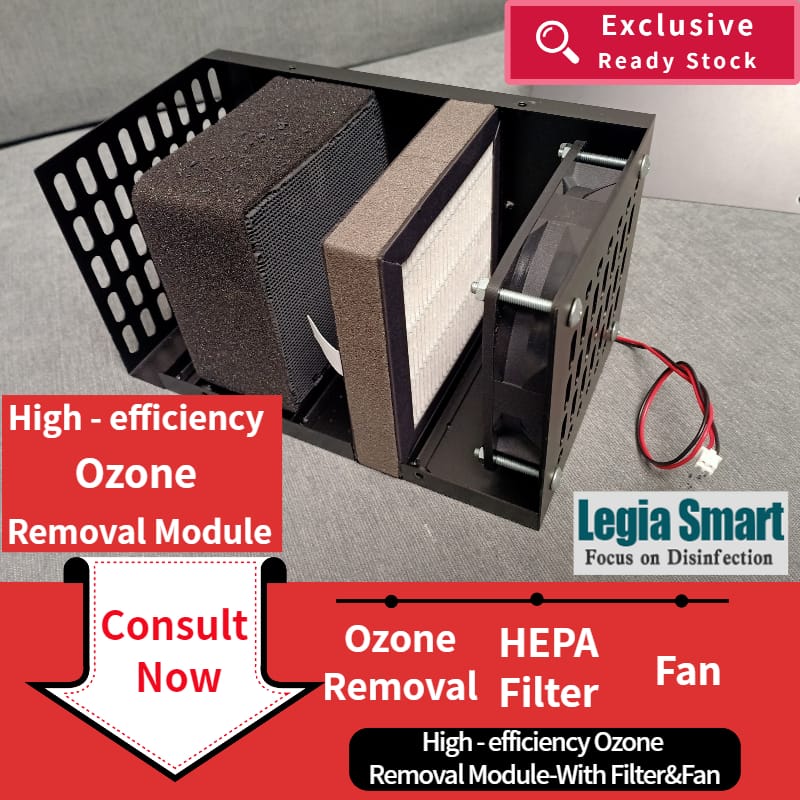
For office equipment and compact low-temperature cavities, see our aluminum-honeycomb Ozone Decomposition Filter for Printers & Copiers. For a complete plug-and-play assembly with fan and HEPA pre-filter, see the Rapid Ozone Removal Module with Fan and Filter.
Technical Specifications
| Parameter | Specification |
|---|---|
| Catalyst | Manganese oxide catalyst |
| Catalytic Function | Room-temperature, zero-energy catalytic decomposition of ozone into oxygen |
| Active Component | Supported manganese-based composite metal oxide |
| Appearance | Honeycomb block 100 × 100 × 50mm, square cells, 150 cells/in² (230 cells/in² optional) |
| Catalyst Carrier | Modified porous ceramic/carbon carrier |
| Carrier Specific Surface Area | ≥ 1,500 m²/g |
| Purification Efficiency | ≥ 95–99% (depends on actual working conditions and total catalyst volume) |
| Service Life | Not less than 10,000 h (in a clean environment) |
| Recommended Flow Rate | ≤ 2.0 m/s face velocity |
| Pressure Drop (ceramic, 230 cells/in²) | T=50mm: ~7 Pa @ 0.5 m/s → ~40 Pa @ 2.0 m/s; T=70mm: ~10 Pa → ~45 Pa |
| Pressure Drop (13mm panel, 150/230 cells/in²) | ~5 Pa @ 1 m/s → ~52 Pa @ 4 m/s |
| Packaging | All filters shipped in double-layer cartons |
| Storage | Dry, room-temperature environment |
| Installation | Seal around the filter perimeter so the entire gas stream passes through the catalytic media |
Blocks can be arrayed to any panel size and framed to your duct or cavity dimensions. Send your airflow, ozone concentration, and available depth — we will return a matched configuration.
Frequently Asked Questions
What is the price of the Ceramic Honeycomb Ozone Removal Filter | Mn Catalyst, 95–99% Efficiency, 10,000h?
Legia Smart disinfection equipment typically ranges from USD 50 to 200 depending on capacity, features, and customization. The Ceramic Honeycomb 100×100×50 starts around USD 90. Request a quote for an exact price based on your order volume and configuration.
Do you offer OEM and ODM customization?
Yes. We provide full OEM/ODM services including custom branding, logo printing, packaging, and feature configuration. Our engineering team can adapt the cabinet capacity, sterilization modes, and control panel to your specifications.
What is the minimum order quantity (MOQ)?
MOQ is flexible and depends on the model and customization level. Sample orders are welcome for evaluation. Contact our sales team with your requirements for a tailored MOQ and lead time.
What certifications do your disinfection products carry?
Our equipment is manufactured to ISO and CE quality standards, with full documentation available for export. Compliance reports and test certificates can be provided on request.
What is the lead time and shipping options?
Standard lead time is 15 to 30 days for production, depending on order size and customization. We ship globally by sea or air with complete export documentation and support EXW, FOB, and CIF terms.
What warranty and after-sales support do you provide?
We offer a 12-month warranty against manufacturing defects, backed by remote technical support, spare-parts supply, and installation guidance to keep your equipment running reliably.
Modules & Accessories